Discover how to dial in your fat-to-protein ratio on the Lion Diet. Learn how to calculate daily grams of beef, tallow, and protein to conquer fatigue, heal your gut, and thrive.
We only share products we believe in. Buying through a link may earn us a small commission — thanks for the support. Learn more →
The Lion Diet—an ultra-pure elimination protocol consisting exclusively of ruminant meat, salt, and water—is renowned for its profound anti-inflammatory and autoimmune-healing benefits. However, when you eliminate all carbohydrates, dairy, and plant matter, your body undergoes a foundational shift in how it fuels itself. Many newcomers assume that succeeding on this protocol simply means eating steak whenever hunger strikes, only to run headfirst into fatigue, digestive distress, and brain fog within the first few weeks.
The culprit behind these symptoms is almost always a macronutrient imbalance. Because carbohydrates are non-existent, fat is your sole energetic lifeline, while protein provides structural building blocks. Mastering your lion diet fat to protein ratio is the difference between sluggish survival and thriving with boundless vitality. In this guide, we break down the mechanics of a ruminant-focused carnivore macro calculator so you can determine your precise nutritional targets, daily beef portions, and fat intake.
The Core Problem: Why Protein Alone Fails
When switching to an all-meat diet, instinct often leads people to choose lean ground beef, sirloin, or flank steak. In nutritional science, subsisting exclusively on lean meat without sufficient dietary fat leads to a condition historically known as "protein poisoning" or "rabbit starvation." The human liver has a finite rate at which it can synthesize urea to process protein deamination, typically capped around 35% to 45% of total caloric intake.
Beyond structural maintenance and muscle synthesis, excess amino acids are inefficient for fueling daily metabolic activities. To thrive on the Lion Diet, fat must become your primary fuel substrate. Adequate dietary fat triggers stable ketone production, regulates endocrine function, supports cellular membranes, and prevents energy crashes.
Calories vs. Grams: Demystifying the Ratio
One of the most confusing aspects of using a carnivore macro calculator is the difference between measuring ratios by weight (grams) versus measuring by energy (calories):
- Fat: 9 calories per gram
- Protein: 4 calories per gram
Because fat is more than twice as calorically dense as protein, a 1:1 ratio in grams yields an energy split of roughly 70% fat and 30% protein from calories. Below are the three standard benchmarks used in ruminant elimination diets:
- 1:1 by Grams (~70% Fat / 30% Protein by Calories): The absolute minimum baseline for human metabolic performance on a zero-carb protocol. Suitable for general maintenance, moderate exercise, and individuals transitioning from a standard low-carb regimen.
- 1.5:1 by Grams (~77% Fat / 23% Protein by Calories): The metabolic "sweet spot" for sustained stamina, stable blood sugar, and active individuals who experience sluggishness or constipation at a 1:1 intake.
- 2:1 by Grams (~82% Fat / 18% Protein by Calories): A therapeutic ketogenic ratio. Commonly recommended by functional practitioners and clinicians to treat deep neurological conditions, severe autoimmune flare-ups, and severe gut dysbiosis.
The Lion Diet Macro Formula: Step-by-Step
Unlike complex calorie calculators designed for standard mixed diets, calculating your Lion Diet targets requires a simple three-step sequence anchored to your physiology.
Step 1: Set Your Protein Anchor
Protein requirements should always be pegged to your ideal lean body weight, not your existing scale weight. If your goal weight or estimated lean mass is 160 lbs, you should not calculate protein based on 220 lbs.
- General Baseline: 0.8g to 1.0g of protein per pound of ideal body weight.
- Example: An individual with an ideal target weight of 165 lbs requires approximately 130g to 165g of protein per day.
Step 2: Choose Your Fat-to-Protein Ratio
Once your protein anchor is established, use fat as your adjustable fuel dial:
- Baseline Maintenance (1:1 Ratio): Pair 1g of fat for every 1g of protein. At 150g protein, you need 150g fat (~1,950 total kcal).
- Optimal Performance (1.5:1 Ratio): Multiply your protein target by 1.5. At 150g protein, you consume 225g fat (~2,625 total kcal).
- Therapeutic Healing (2:1 Ratio): Multiply your protein target by 2. At 150g protein, you consume 300g fat (~3,300 total kcal).
Step 3: Translate Targets into Actual Food
Knowing you need 150g of protein and 150g to 225g of fat does not help unless you can visualize it on a butcher block. How many lion diet grams of beef does this translate to?
As a rule of thumb, raw ruminant muscle meat contains roughly 20g to 22g of protein per 100g (or about 6g to 7g per ounce). To hit a target of 150g of protein, an individual requires approximately 700g to 750g of beef per day (approx. 1.5 to 1.7 lbs).
Translating Ratios to Real-World Plates
Achieving a higher fat ratio can be challenging if you rely solely on grocery store ground beef. Consider the macronutrient profiles of common cuts:
- 80/20 Ground Beef (Raw, 100g): ~17g protein, ~20g fat (roughly 1.15:1 fat-to-protein ratio by weight).
- 73/27 Ground Beef (Raw, 100g): ~14g protein, ~27g fat (nearly 1.9:1 fat-to-protein ratio by weight).
- USDA Choice Ribeye (Cooked, trimmed, 100g): ~24g protein, ~22g fat (roughly 0.9:1 fat-to-protein ratio).
- Beef Suet / Pure Tallow (100g): ~0g protein, ~100g fat.
Notice that even a standard 80/20 ground beef mince only reaches a 1.15:1 ratio, and ribeye rarely reaches a true 1:1 ratio once fat renders off in the pan. To achieve a 1.5:1 or 2:1 ratio, you must consciously add fat.
How to Get Enough Fat on the Lion Diet
Since the Lion Diet excludes butter, ghee, and dairy fats, finding and consuming clean ruminant fat is essential to prevent chronic caloric deficits:
- Save Your Drippings: When pan-searing burgers or steaks, pour the rendered fat back over the sliced meat before eating, or allow it to cool into a solid dipping sauce.
- Source Raw Beef Suet: Ask your butcher for raw kidney fat (suet). Pan-fry chilled suet cubes until crisp on the outside while raw and creamy inside.
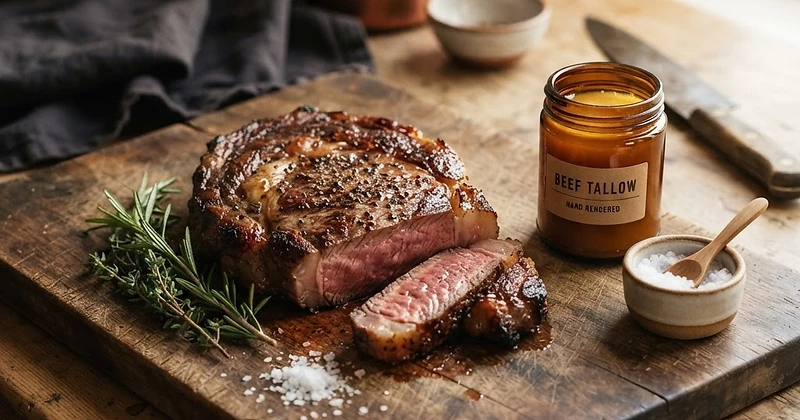
- Homemade Ruminant Tallow: Render down beef or lamb fat in a slow cooker and consume a spoonful alongside leaner cuts like chuck roast or flank steak.
- Include Ruminant Bone Marrow: Roasted marrow bones provide an easily digestible, highly bioavailable fat profile loaded with fat-soluble activators.
Troubleshooting Your Ratios: Reading the Signs
Your digestive tract provides immediate feedback regarding your macro balance:
- Fat Ratio Too High (Loose Stools / Diarrhea): If your gallbladder and gut microbiome have not yet adapted to high bile demands, unabsorbed fat will pass rapidly through the bowel. Temporarily scale back your ratio closer to 1:1 and build up slowly.
- Fat Ratio Too Low (Constipation, Fatigue, Cravings): Hard, infrequent bowel movements coupled with afternoon energy dips and persistent hunger signals that you are consuming excess protein relative to fat. Increase rendered tallow or fatty trimmings immediately.
Actionable Next Steps
To successfully dial in your Lion Diet journey, take these three practical steps today:
- Determine your target weight in pounds and set that number as your daily protein gram target (e.g., 150 lbs = 150g protein).
- Purchase a kitchen scale and track your meat intake for 3 to 5 days using raw weights to understand your baseline.
- Secure a source of pure ruminant fat—such as beef suet or artisanal beef tallow—to supplement your skillet meals until your energy, digestion, and satiety stabilize.
Sources & References