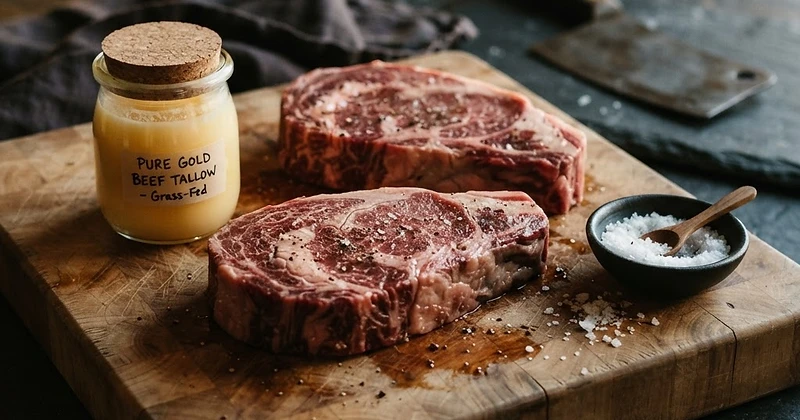
Master the mathematics of the Lion Diet. Learn how to calculate your personalized fat-to-protein ratios, calibrate daily beef intake for true satiety, and source the cleanest ruminant nutrition.
We only share products we believe in. Buying through a link may earn us a small commission — thanks for the support. Learn more →
The Lion Diet—often recognized as the ultimate ruminant-only elimination protocol popularized by Mikhaila Peterson—strips human nutrition down to its foundational elements: ruminant meat, water, and salt. While standard carnivore protocols permit eggs, poultry, pork, and dairy, the Lion Diet leaves no margin for error. Without the broad caloric buffers of butter, heavy cream, or cheddar cheese, achieving sustained energy and metabolic healing requires precision.
Many beginners stumble into common pitfalls: debilitating lethargy, digestive distress, persistent cravings, or protein toxicity ("rabbit starvation"). These issues almost always trace back to an incorrect fat-to-protein ratio. This guide breaks down the mechanics behind a true lion diet calculator, teaching you how to compute caloric needs, pinpoint fat grams, answer the question of how much beef to eat on a lion diet, and master meat sourcing.
The Core Formula: Caloric Baselines and Basal Metabolism
While intuitive eating remains the long-term goal of any ancestral protocol, calculating your baseline metrics acts as a critical sanity check during the introductory weeks. The most reliable formula to establish your basal energy demands is the Katch-McArdle Equation, which calculates Basal Metabolic Rate (BMR) from lean body mass (LBM) rather than total weight:
- BMR (Imperial): 370 + (9.82 × Lean Body Mass in lbs)
- BMR (Metric): 370 + (21.6 × Lean Body Mass in kg)
Once your BMR is determined, apply your daily activity factor:
- Sedentary (desk work, minimal formal exercise): BMR × 1.2
- Lightly Active (walking, training 1–3 days/week): BMR × 1.375
- Moderately Active (intense training 3–5 days/week): BMR × 1.55
- Very Active (demanding physical labor or daily intense athletics): BMR × 1.725
The resulting figure represents your Total Daily Energy Expenditure (TDEE). On a zero-carbohydrate protocol, this caloric total must be divided between just two macronutrients: animal protein and ruminant fat.
Determining Your Lion Diet Macro Ratio: The 70/30 vs. 80/20 Rule
When calculating a carnivore macro calculator split, practitioners evaluate macros in two ways: percentage of total calories versus macronutrient grams on a scale.
1. The Caloric Split (70% to 80% Calories from Fat)
In human biochemistry, fat delivers approximately 9 calories per gram, while dietary protein yields roughly 4 calories per gram. For therapeutic ketosis, immune recalibration, and optimal hormonal balance, your total daily caloric split on the Lion Diet should land between 70% to 80% of calories from fat, with the remaining 20% to 30% derived from protein.
2. The 1:1 Gram-for-Gram Rule
Tracking calories can be cumbersome. Fortunately, the 1:1 gram ratio provides a simple kitchen shortcut: eat equal grams of fat and protein.
For example, consuming 150 grams of protein and 150 grams of fat yields:
- 150g Protein × 4 kcal = 600 kcal
- 150g Fat × 9 kcal = 1,350 kcal
- Total Energy: 1,950 kcal (69.2% calories from fat)
If you need deeper therapeutic ketone production or experience stubborn fatigue, raise your fat ratio to 1.5 grams of fat for every 1 gram of protein, pushing your fat calories past 77%.
Protein Targets: Preserving Muscle and Driving Satiety
A reliable protein target on a carnivore framework falls between 0.8 to 1.2 grams of protein per pound of ideal body weight (or lean body mass) (roughly 1.8 to 2.6 g/kg), as discussed in evidence-informed Carnivore Diet Macros Guides. The lower end serves sedentary individuals seeking immune rest; the higher end supports resistance training, athletic performance, and tissue repair.
Step-by-Step Calculator Walkthrough
Consider an individual with a lean mass of 160 lbs seeking body recomposition and stable energy:
- Daily Protein Goal: 160 lbs × 1.0 g/lb = 160g Protein (640 kcal)
- Calculated TDEE Requirement: 2,400 total calories
- Fat Calorie Deficit to Fill: 2,400 kcal − 640 kcal = 1,760 kcal
- Daily Fat Target: 1,760 kcal ÷ 9 kcal/g = ~195g Fat
- Final Macro Ratio: ~1.2g fat per 1g protein (~73% calories from fat)
How Much Beef to Eat on a Lion Diet?
Translating theoretical macro targets into actual meat on your plate requires understanding meat composition. Cooked muscle meat without visible external fat is approximately 20–25% protein by weight. A standard 16 oz (1 pound) cut of typical raw beef provides roughly 90 to 100 grams of pure protein.
Most adults on a dedicated ruminant regimen find satiety within the following ranges:
- Smaller or Sedentary Adults: 1.25 to 1.75 pounds (approx. 20–28 oz) of fatty ruminant meat per day.
- Average to Active Adults: 2.0 to 2.5 pounds (approx. 32–40 oz) of fatty ruminant meat per day.
- Large Athletes or Manual Laborers: 3.0+ pounds of fatty beef or lamb per day.
Community feedback from carnivore practitioners on Reddit highlights that those who feel drained or constantly hungry are rarely eating too little protein; rather, they are failing to consume sufficient fat alongside their lean meat.
The Satiety Equation: Managing Ratios Without Processed Fats
Because the Lion Diet excludes butter, ghee, and heavy whipping cream, your fat must come exclusively from ruminant sources. Standard ground beef (80/20) and standard ribeyes often fall short of meeting a genuine 75–80% caloric fat demand once excess rendered fat is left behind in the pan.
High-Fat Ruminant Strategies
- Hard Suet & Raw Fat Trimmings: Request untrimmed beef kidney suet or fat caps from your local butcher. Lightly pan-sear suet chunks until crispy on the outside while keeping the center firm.
- Home-Rendered Tallow: Save all liquid drippings from roasted chuck or brisket. Pour your rendered tallow directly back over cooked steaks as a warm dipping sauce.
- Fat-Dense Ruminant Cuts: Emphasize beef short ribs, brisket points, lamb ribs (breast), oxtails, and 70/30 or 73/27 ground beef blends. Expert meal designs, such as the Nutrition with Judy Lion Diet Meal Plan, frequently integrate raw suet or lamb neck to sustain adequate fat ratios.
Sourcing Your Meat: Conventional Grain-Fed vs. Regenerative Grass-Finished
When selecting your ruminant meat, sourcing choices directly influence your fatty acid profiles, micronutrient availability, and long-term vitality.
| Metric / Attribute | Grain-Finished Beef | 100% Grass-Finished / Pasture-Raised |
|---|
| Omega-6 to Omega-3 Ratio | Higher (approx. 7:1 to 9:1) | Optimal (approx. 1.5:1 to 2:1) |
| Conjugated Linoleic Acid (CLA) | Moderate | Up to 300–500% higher concentrations |
| Micronutrient Density | Standard B-vitamins, zinc, iron | Elevated Vitamin A (carotenoids), Vitamin E |
| Palatability & Fat Softness | Sweeter taste, softer marbling | Earthier, firmer fat profile with yellow tint |
| Accessibility & Cost | Affordable, ubiquitously available | Premium cost; best sourced via local regenerative farms |
While 100% grass-finished beef offers an optimal anti-inflammatory profile, commercial grain-finished ruminant meat remains metabolically viable for those starting out on a budget. Ruminant digestive tracts naturally convert problematic polyunsaturated fats into stable saturated and monounsaturated stearic and oleic acids, making even standard grocery store beef far superior to conventional pork or poultry.
Recognizing Hunger Signals: When to Stop and When to Add Fat
Utilizing carnivore diet tools and macro calculators provides a steady compass, but metabolic adaptation ultimately requires reconnecting with somatic satiety cues. Unlike carbohydrate-driven hunger—marked by sudden blood sugar dips, shakiness, and irritability—ruminant satiety operates via leptin, cholecystokinin (CCK), and peptide YY (PYY) signaling.
- Too Much Lean, Not Enough Fat: You feel physical fullness in your stomach from dense protein, yet you continue craving food, experience low energy 45 minutes post-meal, or suffer from constipation.
- Too Much Liquid Fat Too Quickly: You experience sudden loose stools, nausea, or digestive discomfort. Dial back hot liquid fats and transition toward solid, chilled fat trimmings or cold suet.
- True Metabolic Satiety: The meat stops tasting palatable. When a bite of salted ribeye no longer tastes rewarding, put the plate away. Satiety on the Lion Diet is unmistakable.
Next Steps: Action Plan
- Calculate Your Baselines: Estimate your lean body mass and identify your daily protein baseline (0.8–1.0 g per lb of LBM).
- Match Fat Grams 1:1: Ensure your daily fat intake matches or exceeds your protein intake gram for gram.
- Secure Fat Trimmings: Contact a local butcher to secure beef fat trimmings or pure suet before you begin.
- Eat to Satiety Twice Daily: Divide your daily beef requirement into two meals, season generously with unrefined salt and water, and reassess your energy and digestion across your first 30 days.
Sources & References