Organ Meats vs Muscle Meat: The Carnivore Nutrient Density and Micronutrient Guide
← All articles
Supplements & ElectrolytesCarnivore

Organ Meats vs Muscle Meat: The Carnivore Nutrient Density and Micronutrient Guide

A deep dive comparing the micronutrient density of organ meats versus muscle meat on the carnivore diet. Learn how to prevent nutrient deficiencies, master beef liver intake, and optimize nose-to-tail eating.

By Editorial Team

We only share products we believe in. Buying through a link may earn us a small commission — thanks for the support. Learn more →

When modern eaters adopt an animal-based diet, their instincts usually lead them to the steak counter. Juicy ribeyes, sizzling ground beef, and crispy pork chops serve as the staple foundation for many beginners. However, within the ancestral health community, a pivotal debate continues to spark intense discussion: Is muscle meat alone enough, or are organ meats essential to optimize human physiology?

While ribeyes deliver world-class complete protein, steady fat-soluble energy, and crucial compounds like creatine, they fall short of providing the full spectrum of vitamins and trace minerals human ancestors thrived on. Transitioning toward a nose-to-tail framework by incorporating organ meats on carnivore shifts your nutrition from mere sustenance to biological optimization.

In this comprehensive guide, we break down the definitive comparison between organ meats and muscle meat, examine how to prevent carnivore diet nutrient deficiencies, uncover the power of a beef liver carnivore diet protocol, and explore how to use carnivore organ supplements effectively.

The Biological Divide: Understanding Muscle vs. Organ Meats

To understand why these meats have drastically different nutritional profiles, look at their biological function inside an animal's body.

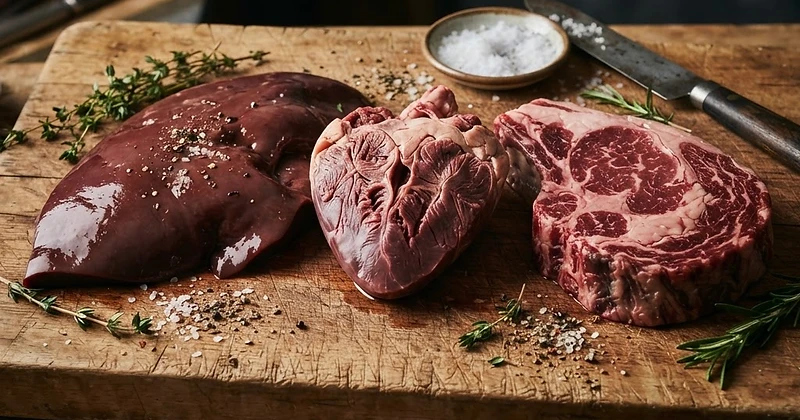
  • Muscle Meat: Skeletal muscles (such as strip loins, briskets, and ribs) are built for kinetic work, mechanical contraction, and structural locomotion. They are densely packed with high-quality contractile proteins (actin and myosin), saturated and monounsaturated fatty acids, and performance-enhancing amino metabolites like carnosine, anserine, and creatine.
  • Organ Meats (Offal): Internal organs (such as liver, heart, kidneys, and spleen) function as the body's metabolic factories, filtration hubs, and biochemical power plants. Because they execute intense cellular reactions, they store high concentrations of bioavailable vitamins, cofactors, enzymes, and trace elements.

Clinical dietary modeling, including research highlighted in PubMed on the nutrient composition of the carnivore diet, demonstrates that while strict muscle meat meal plans excel in providing zinc, iron, selenium, and B-complex vitamins like B3 and B12, they can leave gaps in folate, vitamin A, copper, and vitamin C. Incorporating offal transforms these nutritional deficits into surpluses.

Direct Micronutrient Comparison: Liver, Heart, and Muscle Meat

To quantify the difference, let us compare 100 grams of typical beef muscle meat (ribeye/ground beef) against 100 grams of beef liver and beef heart:

  • Vitamin A (Retinol): Muscle meat contains modest traces. In contrast, 100 grams of raw beef liver can deliver over 400% to 600% of the daily recommended intake of preformed vitamin A. This vitamin acts as a vital regulator for vision, immune cell proliferation, and thyroid hormone function.
  • Folate (Vitamin B9): Skeletal muscle is notoriously low in folate. Beef liver and kidney are abundant sources, delivering the cofactors required for healthy DNA synthesis, methylation, and homocysteine regulation.
  • Coenzyme Q10 (CoQ10): Heart tissue undergoes constant aerobic contraction, concentrating the highest natural levels of CoQ10 in the animal kingdom. CoQ10 supports mitochondrial ATP synthesis and cardiovascular endurance.
  • Copper & Iron Balance: While red muscle meat supplies heme iron, beef liver provides exceptionally dense heme iron paired with bioactive copper. Copper is essential for ceruloplasmin production, enabling your body to properly recycle and transport iron rather than depositing it oxidatively into tissues.
  • Choline: Essential for cell membrane integrity, neurotransmitter synthesis (acetylcholine), and healthy liver lipid transport, choline is far more concentrated in liver and egg yolks than in standard cuts of muscle meat.

The Vitamin C Conundrum and Carnivore Deficiencies

One of the most common medical critiques of all-meat regimens is the risk of scurvy. Conventional nutritional science assumes that without citrus or leafy greens, vitamin C depletion is inevitable.

However, recent scoping reviews, such as those published in PubMed Central on carnivore diet health outcomes, highlight that glucose and ascorbic acid (vitamin C) compete directly for cell uptake via glucose transporters (GLUT-1). On a zero-carb carnivore diet, circulating blood glucose remains steady and low, which substantially enhances cellular ascorbic acid uptake and decreases daily turnover requirements.

Furthermore, organ meats—particularly beef liver, spleen, and adrenal glands—contain measurable quantities of active vitamin C. Consuming fresh, lightly cooked organs alongside pasture-raised animal foods completely satisfies functional ascorbic acid needs for tissue remodeling and collagen synthesis without needing plant carbohydrates.

Beef Liver: The True "Nature's Multivitamin"

Within the animal-based sphere, beef liver reigns supreme. There is virtually no synthetic multivitamin that matches the bioavailability, co-factor synergy, and enzymatic balance of fresh ruminant liver.

Join the Community

Create your free account to access personalized targets, daily tracking, and lifestyle guidance tailored to your diet path.

Sign Up Free

Key Advantages of Beef Liver:

  • Energy Metabolism: Packed with the full family of B-complex vitamins (riboflavin, B6, folate, B12), supporting enzymatic breakdown of fats for fuel.
  • Immune Resilience: High concentrations of preformed retinol and bioavailable zinc promote skin, mucosal, and cellular barrier defenses.
  • Optimal Blood Building: Packed with bioavailable heme iron, vitamin B12, and copper, which work synergistically to produce robust red blood cells.

Can You Eat Too Much Liver?

Yes. While organ meats are nutritional goldmines, more is not always better. Because liver is saturated with preformed vitamin A (retinol), chronic hypervitaminosis A is a real possibility if eaten in massive quantities daily. Retinol is fat-soluble and stored in human liver tissue.

Additionally, individuals with hereditary hemochromatosis or sensitivity to excessive copper accumulation need to monitor their organ intake. A balanced, sustainable approach for a beef liver carnivore diet is consuming 100 to 150 grams (3.5 to 5 ounces) per week. This small weekly serving covers all baseline trace micronutrient needs without tipping into mineral or retinol toxicity.

The Role of Heart, Kidney, and Bone Marrow

While liver commands the spotlight, nose-to-tail eating encompasses the broader spectrum of offal:

  • Beef Heart: Technically an organ, but structurally similar to muscle meat. Heart has a mild flavor and rich texture while delivering mega-doses of CoQ10, elastin, and collagenous peptides. It is one of the easiest organ meats for beginners to prepare.
  • Beef Kidney: A top-tier source of selenium and vitamin B12, kidney supports renal function, cellular detoxification pathways, and thyroid hormone conversion.
  • Bone Marrow: Packed with conjugated linoleic acid (CLA), alkylglycerols (which support white blood cell production), and dense fat-soluble vitamins, marrow provides clean, calorie-dense satiety.

Overcoming Palatability: Fresh Offal vs. Carnivore Organ Supplements

The primary barrier to consuming organ meats is taste and texture. Many individuals raised on a standard Western diet find offal's distinct metallic aroma and dense mineral profile difficult to enjoy.

Actionable Strategies for Fresh Organs:

  1. The 80/20 Grind: Blend 15–20% raw ground liver or heart into 80% regular ground chuck. Sautéed with salt, tallow, and bacon, the organ flavor is virtually imperceptible.
  2. Flash-Frozen "Pills": Dice fresh grass-fed liver into small pea-sized cubes, freeze them separately on parchment paper, and swallow a few frozen pieces whole with water each morning.
  3. Liver Pâté: Gently cook liver in grass-fed butter, ghee, or bacon fat, and whip it into a smooth paste seasoned with coarse sea salt.

The Convenience of Desiccated Organ Supplements:

If sourcing clean offal or enduring the flavor is impractical, carnivore organ supplements offer a viable alternative. Quality manufacturers freeze-dry raw, pasture-raised organs into shelf-stable, encapsulated powders. This low-temperature dehydration process preserves delicate heat-sensitive peptides, enzymes, and vitamins without demanding kitchen prep.

When selecting organ supplements, look for grass-fed, pasture-finished certifications, third-party purity testing, and zero synthetic fillers or flow agents (such as magnesium stearate or silicon dioxide).

Conclusion: Structuring Your Nose-to-Tail Blueprint

You do not need to choose between muscle meat and organ meats. True dietary optimization pairs the structural protein, creatine, and calories of muscle meats with the focused micronutrient density of offal.

To establish a bulletproof carnivore lifestyle:

  • Make high-quality, fatty muscle meats (ribeyes, chuck roasts, ground beef, lamb) the caloric bedrock of your diet.
  • Integrate 3 to 5 ounces of ruminant liver weekly to satisfy micronutrient baselines.
  • Add heart, kidney, or marrow when available for variety and mitochondrial support.
  • Keep high-grade desiccated organ capsules on hand when traveling or tight on time.

By respecting ancestral biology and adopting a nose-to-tail framework, you build an ironclad nutritional foundation that elevates mental clarity, hormonal health, and physical vitality.

Sources & References

Join the Community

Create your free account to access personalized targets, daily tracking, and lifestyle guidance tailored to your diet path.

Sign Up Free

We use cookies and similar technologies to operate the site and improve your experience. By continuing, you agree to our use of non-essential cookies. See our Privacy Policy.