Think the carnivore diet requires expensive ribeyes? Discover how to thrive on an animal-based diet on a budget using cheap cuts, ground beef hacks, and bulk buying.
We only share products we believe in. Buying through a link may earn us a small commission — thanks for the support. Learn more →
Scroll through social media, and you would be forgiven for assuming the carnivore diet is an elite lifestyle reserved for those who can afford pasture-raised, dry-aged ribeyes every night. Influencers frequently showcase thick cuts of Prime steaks sizzling in cast-iron pans, perpetuating the myth that eating exclusively animal products will drain your bank account.
The reality? A cheap carnivore diet is not only entirely possible, but it is often significantly cheaper than a standard grocery haul packed with processed snacks, fresh produce that spoils before you eat it, and high-end artisanal sauces. By mastering inexpensive meat cuts carnivore veterans swear by, optimizing versatile workhorses like ground beef, and learning simple bulk-sourcing strategies, you can maintain peak health without overspending.
The Myth of the "Ribeye-Only" Carnivore Diet
The core philosophy of the carnivore or lion diet is simple: eliminate anti-nutrients, plant toxins, and refined carbohydrates while nourishing your physiology with bioavailable animal fats and proteins. Your body does not demand that micronutrients come exclusively from a $20-per-pound steak; it requires essential fatty acids, complete amino acids, bioavailable iron, zinc, and B vitamins. In fact, many budget-friendly cuts contain just as much—if not more—nutritional density and connective tissue as luxury cuts.
As highlighted in budget-friendly carnivore guides by outlets like People's Choice Beef Jerky, an individual consuming roughly 2 to 2.5 pounds of ground beef per day can thrive on approximately $10 to $12 daily. When you consider that you no longer spend money on takeout lunches, coffee syrups, appetizers, or wasted perishable vegetables, your net grocery bill frequently decreases.
The Best Inexpensive Meat Cuts for Carnivore
When curating your shopping list, bypass the tenderloin and ribeye sections and look for cuts that provide generous fat content and connective tissue at a fraction of the cost.
1. Chuck Roast: The Poor Man's Ribeye
Chuck roast comes from the shoulder and contains rich marbling and robust beef flavor. While too tough to quickly sear like a strip steak, chuck roast transforms under low, slow heat. Braising a 3- to 4-pound chuck roast in a slow cooker or Dutch oven with nothing more than water, salt, and beef tallow yields fall-apart shredded beef that covers days of meals.
2. Beef Brisket
A whole packer brisket consists of the lean "flat" and the luscious "point." Brisket is often priced competitively per pound compared to individual steaks. Roasting or smoking a full brisket gives you massive fat-to-protein ratios, keeping you sated for hours.
3. Beef Shanks and Stew Meat
Beef shanks are cross-cut sections of the leg containing a center marrow bone surrounded by tough muscle. The marrow provides rich fat-soluble vitamins and healthy lipids, while slow-cooking breaks down the collagen into gelatin. Stew meat, often cut from rounds or chuck, provides affordable, bite-sized protein that pairs well with tallow or butter.
4. Pork Shoulder (Pork Butt) and Pork Belly
Pork is widely affordable and high in healthy fats. A bone-in pork shoulder can frequently be found on sale for under $2.50 per pound. Slow-roasted or pressure-cooked carnivore carnitas (seasoned solely with sea salt) make an economical alternative to beef.
5. Bone-In Chicken Thighs
While ruminant meats (beef, lamb) should form the foundational anchor of a carnivore lifestyle due to their superior fatty acid and micronutrient profiles, dark-meat chicken like skin-on thighs and drumsticks provides an inexpensive protein source. Pan-fry them in beef tallow or lard to increase their fat content.
Ground Beef Hacks: The Budget Carnivore Anchor
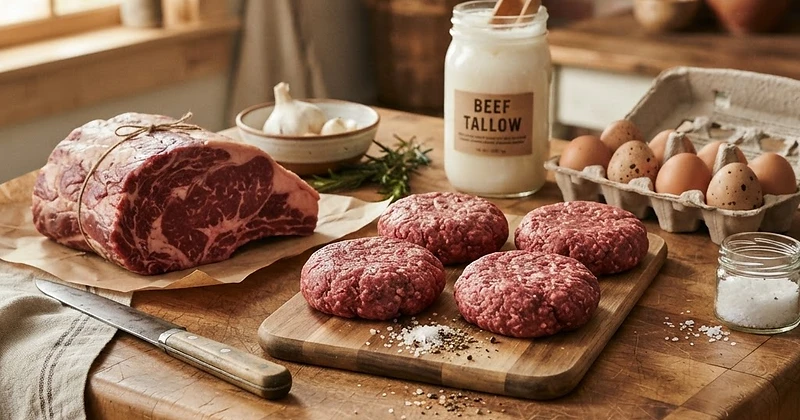
Ground beef is the undisputed hero of the carnivore diet on a budget. It is readily available, simple to portion, fast to prepare, and naturally balanced in macro-ratios. Choosing 73/27 or 80/20 ground beef is not only cheaper than leaner grinds (such as 90/10), but it also gives you the dietary fat essential for sustained energy and hormone production.
- The Burger Bowl: Brown a pound of 80/20 ground beef in a skillet. Do not drain the fat. Season generously with mineral salt, slide it into a bowl, and top with two fried eggs. The runny yolk blends with the rendered tallow to create a rich sauce.
- Make Smash Patties: Press quarter-pound beef balls onto a smoking-hot cast-iron pan until thin and crispy around the edges. Crispy textures prevent flavor fatigue without needing sauces or spices.
- Carnivore Meatloaf / Meat Bricks: Mix two pounds of ground beef with two raw eggs, salt, and crushed pork rinds (optional for binding). Bake into a loaf, cool, slice, and freeze individual portions for quick grab-and-go fuel.
- Never Discard Rendered Fat: Pour any extra liquid fat left in your skillet into a heat-safe glass jar. Keep it in your refrigerator to use as high-smoke-point cooking tallow for leaner meats or eggs.
Bulk Buying and Sourcing Strategies
To drop your per-pound food cost significantly, take control of your sourcing using these proven strategies:
1. Wholesale Clubs
Warehouses like Costco, Sam's Club, or BJ's carry whole subprimal cuts (such as whole chuck rolls, strips, or pork loins). Slicing these into individual roasts or steaks yourself using a sharp boning knife saves substantial markup compared to pre-packaged butcher cuts.
2. Buying a Quarter or Half Cow
Connecting directly with local ranchers via resources like eatWILD or local livestock auctions lets you purchase a quarter, half, or whole cow. While this requires an upfront investment and a dedicated chest freezer, the cost per pound covers everything from ground meat to high-end ribeyes and soup bones at a flat, deeply discounted average rate.
3. Grocery Store Markdowns
Visit grocery store meat counters first thing in the morning. Many supermarket meat managers mark down cuts approaching their "sell-by" dates by 30% to 50%. These meats are completely safe to consume; simply cook them that day or seal and store them immediately in the freezer.
High-Nutrient, Low-Cost Additions
As documented in dietary guides from WebMD and PaleoPro, a complete carnivore regimen can include several cost-effective animal products that expand nutrient diversity:
- Eggs: Eggs are an affordable superfood, supplying choline, lutein, and vitamin K2. Scrambling eggs in residual beef fat is one of the cheapest nutrient-dense meals available.
- Beef Liver: Often retailing for as little as $3 to $4 per pound, beef liver is nature's multivitamin. Just 3 to 4 ounces once or twice a week delivers substantial amounts of copper, iron, bioavailable vitamin A, and B12.
- Canned Sardines and Mackerel: Buy varieties packed strictly in spring water or their own natural oils (avoid seed oils like soybean or sunflower). These provide cheap, bioavailable omega-3 fatty acids, calcium, and iodine.
A Sample 7-Day Budget Carnivore Meal Plan
Here is an accessible, nutrient-packed budget carnivore meal plan designed to keep average daily food costs under $12 to $15:
- Monday:
- Meal 1: 3-4 fried eggs cooked in butter or beef tallow with 2 burger patties (80/20).
- Meal 2: 1/2 lb 80/20 ground beef skillet scramble topped with melted sharp cheddar (if dairy tolerant).
- Tuesday:
- Meal 1: 3 hard-boiled eggs and a can of wild sardines in water.
- Meal 2: Slow-cooked beef chuck roast (shredded) with pan juices.
- Wednesday:
- Meal 1: Leftover shredded chuck roast crisped in a skillet with 2 eggs.
- Meal 2: Crispy skin-on chicken thighs seared in rendered beef tallow.
- Thursday:
- Meal 1: 80/20 smash burgers (approx. 3/4 lb total) seasoned with mineral salt.
- Meal 2: 1/2 lb ground beef mixed with 2-3 oz seared beef liver.
- Friday:
- Meal 1: 4 scrambled eggs with brown butter.
- Meal 2: Slow-cooked bone-in pork shoulder roast.
- Saturday:
- Meal 1: Leftover pulled pork crisped in tallow.
- Meal 2: 1 lb ground beef bowl with rendered fat and a touch of salt.
- Sunday:
- Meal 1: 3-egg omelet with ground beef filling.
- Meal 2: Reverse-seared budget cut (such as top round, tri-tip, or bottom round marinated in water/salt and basted generously with butter).
Final Thoughts & Action Steps
Achieving optimal metabolic health, mental clarity, and fat loss through an animal-based diet does not require top-shelf butcher cuts. Prioritize 80/20 ground beef, seek out discounted roasts, incorporate nutrient-dense eggs and liver, and store bulk cuts in your freezer. By turning simple cuts into satisfying, nutrient-rich meals, you make this lifestyle both biologically optimal and financially sustainable for the long run.