Master the art of minimalist cooking on the Lion Diet. Learn how to render pure beef tallow, sear edge-to-edge crusty steaks, and roast tender cuts using nothing more than ruminant beef, coarse salt, and water.
We only share products we believe in. Buying through a link may earn us a small commission — thanks for the support. Learn more →
When following the Lion Diet—the most restrictive, therapeutic elimination form of the carnivore lifestyle—your pantry is stripped down to the absolute biological essentials: ruminant meat, animal fat, pure water, and salt. While this minimalist framework offers extraordinary autoimmune and gut-healing benefits, beginners often wonder: How do you create restaurant-quality flavor, tender roasts, and crispy textures without spices, marinades, butter, or garlic?
The secret lies in mastering elemental culinary physics. When you master heat, moisture, and extraction, beef fat transforms into velvety liquid gold, tough muscle fibers melt into succulent shreds, and a dry-brined steak develops an unforgettable, caramelized crust. Here is your definitive, authoritative guide to culinary excellence on the Lion Diet using only beef, tallow, coarse salt, and water.
The Core Pillar: How to Render Pure Beef Tallow at Home
Rendered beef tallow is essential for any carnivore kitchen. With a smoke point well above 400°F (204°C), high chemical stability, and a dense concentration of bioavailable fat-soluble vitamins (A, D, E, K2) and conjugated linoleic acid (CLA), tallow is the ultimate non-inflammatory cooking fat, as detailed by The Prairie Homestead. Rendering your own tallow guarantees zero seed oil contamination, synthetic preservatives, or hydrogenated adulterants.
Selecting the Fat: Suet vs. Trim
Understanding your source material determines your final product:
- Kidney Suet: The hard, crumbly visceral fat surrounding the kidneys and loin. Suet yields a pristine, snow-white, nearly odorless tallow that is rock-hard at room temperature—ideal for everyday searing and deep-frying.
- Subcutaneous Muscle Trim: Softer surface fat trimmed from briskets, ribeyes, and chuck roasts. Trim produces a slightly meatier-tasting, softer, pale-golden tallow that is exceptional for pan-basting.
Step-by-Step Wet Rendering Method
While fat can be rendered dry, using the wet rendering technique—adding a small amount of pure water to the pot—is the most foolproof way to prevent scorching and ensure maximum clarity, as highlighted by culinary guides like Ancestral Kitchen and Forager Chef.
- Prep the Fat: Place 3 to 5 pounds of fat in the freezer for 45 minutes until firm. Cut it into fine 1/2-inch cubes, or run it through a coarse meat grinder plate. The greater the surface area, the faster and cleaner the yield.
- The Cooker: Place the fat into a heavy-bottomed Dutch oven or a slow cooker. Add 1/2 cup of pure water and 1 teaspoon of non-iodized coarse sea salt. The water acts as a thermal buffer, ensuring heat disperses evenly before the fat liquefies.
- Slow Simmer: Set your slow cooker to Low (or your stovetop to medium-low). Keep the lid slightly ajar to let steam escape. Let it simmer gently for 4 to 6 hours. You will hear gentle bubbling as moisture evaporates, and the solid tissue bits (cracklings) will begin to brown and sink, then float to the surface.
- Strain and Clarify: Once the liquid is clear and the bubbling has stopped (indicating all residual water has evaporated), turn off the heat. Allow it to cool slightly, then pour through a fine-mesh strainer lined with unbleached cheesecloth into dry glass mason jars.
- Storage: Store sealed jars in a cool, dark pantry for months, or in the refrigerator for up to a year. Always ensure no water droplets remain in your stored jar, as moisture is the sole enemy of tallow's long shelf life.
Mastering the Steaks: Cast Iron Sear with Salt and Steam
A frequent mistake in pure Lion Diet cooking is grey, steamed meat resulting from low heat and excess surface moisture. To achieve an edge-to-edge golden Maillard crust without seasoning powders or black pepper, leverage the power of dry brining and precision thermal contact.
The Dry-Brine Technique
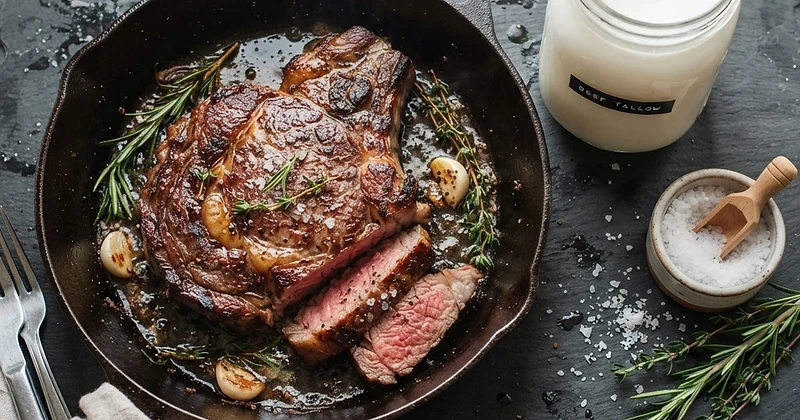
Generously season your steak (such as a 1.5-inch thick bone-in ribeye or New York strip) on all sides with high-quality coarse mineral salt or unrefined sea salt. Place it uncovered on a wire rack inside your refrigerator for 12 to 24 hours. The salt initially draws out cellular water, dissolves, and is reabsorbed deeply into the muscle protein matrix, breaking down tough fibers. Concurrently, the circulating cold air completely dries the exterior surface, establishing the ideal foundation for rapid caramelization.
The Perfect Pan Sear
- Thermal Prep: Remove the steak from the fridge 20 minutes before cooking. Heat a heavy cast-iron skillet over medium-high heat until water droplets dance and vaporize instantly across its surface, a reliable heat check noted in the Lion Diet Guidelines.
- The Sizzle: Melt 1 to 2 tablespoons of your freshly rendered tallow in the skillet. Gently lay down the steak away from you. You must hear an immediate, aggressive sizzle. Resist the urge to slide the meat around; allow it to maintain firm contact undisturbed for 2.5 to 3 minutes to build a deep crust.
- Flip and Baste: Flip the steak once. Spoon the hot, rendered beef fat pooling in the skillet continuously over the top crust for an additional 2 to 3 minutes until an internal probe thermometer reads 125°F (52°C) for medium-rare.
- Rest: Transfer the steak to a warm plate and let it rest for 8 to 10 minutes to allow moisture and melted tallow to equilibrate throughout the meat. Sprinkle a finishing pinch of coarse flaky salt over the sliced steak before serving.
Tender, Succulent Roasts: Braising and Slow Cooking with Salt and Water
Tough, collagen-dense cuts like chuck roast, brisket, shank, and oxtail are the backbone of affordable, nutrient-dense Lion Diet meal ideas. Conventional culinary wisdom suggests braising in red wine, stock, onions, and herbs, but beef inherently contains everything required to create a rich, savory gelatin broth using only water and salt.
The High-Collagen Pot Roast Method
- The Sear: Pat a 3- to 4-pound chuck roast thoroughly dry and coat generously with sea salt. Sear all sides in 2 tablespoons of beef tallow in an oven-safe Dutch oven until dark and caramelized.
- Deglaze with Water: Remove the meat briefly. Pour 1 cup of hot water directly into the scorching pot. Use a wooden spatula to scrape up every bit of fond (browned proteins) stuck to the bottom. This liquid fond turns simple tap water into a deeply savory, single-ingredient beef jus.
- The Low-and-Slow Braise: Return the roast to the pot, adding just enough water so the liquid reaches one-third of the way up the side of the meat. Cover tightly with an oven-safe lid and transfer to an oven preheated to 275°F (135°C), or set your slow cooker to Low for 6 to 8 hours.
- The Reduction: When the meat is fork-tender, lift the roast out. Place the cooking pot on the stovetop over medium heat and rapidly boil the remaining cooking juices for 5 to 7 minutes until reduced by half. The naturally rendered marrow fat and extracted collagen reduce into a thick, glossy, emulsified gravy. Ladle this liquid back over the pulled beef.
Managing Histamines: A Critical Note for Lion Dieters
Many individuals adopt the Lion Diet specifically to overcome severe histamine intolerance, mast cell activation, or autoimmune gut permeability. As the foundational Lion Diet Recipes & Guide points out, slow-cooking meat for multiple hours on low heat allows naturally occurring histamines to accumulate significantly.
If you experience post-meal flushing, brain fog, sinus irritation, or headaches after consuming slow-cooked roasts, shift your strategy. Use an electric pressure cooker (Instant Pot) to cook tough cuts under high pressure with water and salt in just 45 to 60 minutes, or pivot to unaged fresh cuts and high-heat air-frying. Cool leftovers rapidly and freeze portions immediately to arrest histamine formation.
Lion Diet Kitchen Mastery: Practical Takeaways
- Keep it dry for crusts, wet for braises: Surface moisture is your enemy when pan-searing steaks, but water is your greatest ally for dislodging browned pan drippings into natural gravy.
- Render in bulk: Prepare a 5-pound batch of beef tallow every two months. Having shelf-stable ruminant fat readily available makes fast, high-heat cooking frictionless.
- Don't fear the fat cap: When roasting or searing cuts like picanha, brisket, or strip loins, start cooking on the fat cap edge first to render out natural lubricant into the pan before searing the lean faces.
- Salt with intention: Large crystal grains (kosher or coarse sea salt) provide ideal moisture extraction during pre-salting, while fine or flaky mineral salts make the ideal crunchy topping right before eating.
Adopting the Lion Diet strips away distracting sauces and culinary shortcuts, demanding that you honor the fundamental quality of ruminant meat. By relying solely on natural fat, clean water, heat management, and mineral salt, you will not only reclaim metabolic and immune health—you will master the pure art of steak and tallow cooking at its most delicious foundation.
Sources & References