Wondering if dairy belongs on an all-meat protocol? Explore the carnivore hierarchy to see how milk, cheese, and butter affect ketosis, digestion, and fat intake.
We only share products we believe in. Buying through a link may earn us a small commission — thanks for the support. Learn more →
When transitioning to an all-meat protocol, one of the most common debates centers around a single question: can you have dairy on the carnivore diet?
Because dairy comes directly from animals, purists and beginners alike often wonder why it remains such a controversial gray area. While butter, heavy cream, milk, and cheese all originate from cows, goats, or sheep, their biochemical composition varies drastically. Some dairy foods act as potent fuel to hit your critical fat-to-protein ratios, while others can stall weight loss, spark systemic inflammation, or spike blood sugar.
Whether you follow a strict elimination protocol or a relaxed carnivore lifestyle, understanding how dairy impacts your metabolism will help you optimize your results.
The Carnivore Spectrum: Where Does Dairy Fit?
The role of dairy on the carnivore diet depends largely on which tier of the lifestyle you follow and your specific health goals:
- The Lion Diet: The most restrictive elimination tier, consisting exclusively of ruminant meat (beef, lamb, bison), salt, and water. All dairy, including butter, is strictly excluded to eliminate potential autoimmune and digestive triggers.
- Strict Carnivore: Allows all animal meats, seafood, eggs, and occasionally animal cooking fats like tallow or ghee. Dairy containing milk sugars or milk proteins (casein and whey) is avoided.
- Standard / Relaxed Carnivore: Permits all animal products, including low-carb, nutrient-dense dairy options like aged cheese, heavy cream, and butter, provided they do not cause digestive distress or stall progress.
- Ketovore: A hybrid approach emphasizing fatty animal meats with tactical inclusions of full-fat dairy to maintain nutritional ketosis.
Butter on Carnivore: The Uncontested Staple
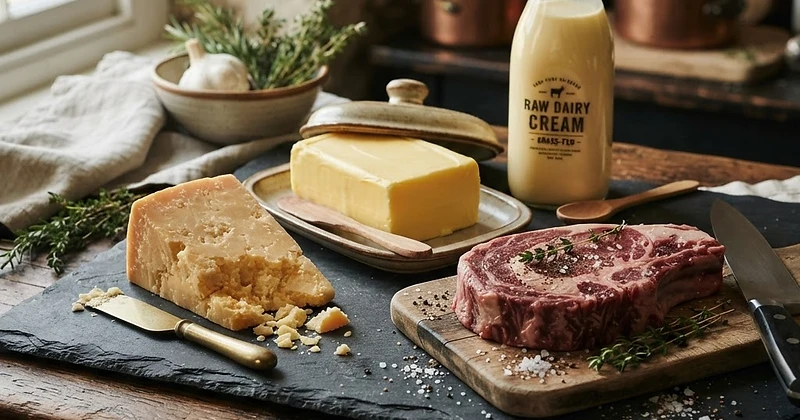
If there is one dairy product that earns universal acclaim across nearly every carnivore circle, it is butter on carnivore. Unlike liquid milk, butter is almost entirely fat, typically consisting of approximately 80% to 82% milkfat, 16% to 18% water, and only negligible trace amounts of milk solids (carbohydrates and protein).
Why Butter Is Essential for Many Carnivores
On a zero-carb protocol, fat is your primary metabolic fuel. Without sufficient fat, dieters risk experiencing "rabbit starvation" or severe fatigue. Adding grass-fed butter to leaner cuts like sirloin or wild game provides clean calories and essential fat-soluble vitamins such as vitamin A, vitamin D, and vitamin K2, alongside conjugated linoleic acid (CLA) and butyrate, a short-chain fatty acid that supports gut lining integrity.
Butter vs. Ghee
If you suspect an underlying sensitivity to milk proteins, ghee (clarified butter) is an ideal alternative. Making ghee involves simmering butter to evaporate the moisture and skimming off the milk solids, resulting in virtually zero lactose or casein. This makes ghee well-tolerated even by individuals sensitive to conventional dairy.
Carnivore Diet Cheese: Which Varieties Work Best?
Can you enjoy carnivore diet cheese without compromising your metabolic health? The answer depends on cheese processing, aging, and individual digestive tolerance.
Hard and Aged Cheeses (The Best Options)
During the natural aging process, beneficial bacteria consume the lactose (milk sugars) present in the curd. Consequently, hard, aged cheeses contain less than 1 gram of carbohydrate per 100 grams, making them virtually lactose-free:
- Parmigiano-Reggiano
- Aged Cheddar (12+ months)
- Pecorino Romano
- Gruyère and Gouda
- Manchego (made from sheep's milk, which many find easier to digest)
Soft and Fresh Cheeses (Proceed with Caution)
Fresh cheeses retain significantly higher levels of whey and lactose. A serving of cottage cheese or ricotta can deliver 4 to 6 grams of carbohydrates per serving, which can quietly drive up daily carbohydrate intake and stimulate insulin production. Limit or monitor items such as:
- Cottage cheese
- Ricotta
- Fresh mozzarella and burrata
- Brie and Camembert
- Processed cheese singles and cheese dips (strictly avoid due to emulsifiers, preservatives, and vegetable oils)
The Risks: Overeating and Weight Stalls
Cheese combines fat, salt, and trace casomorphins—opiate-like peptide fragments formed during the digestion of casein. This combination makes cheese hyperpalatable. Many carnivores who hit weight-loss plateaus find that eliminating cheese resolves their stalls because it removes hidden calories and accidental snacking triggers.
Can You Drink Milk on Carnivore?
A frequent question from beginners is: can you drink milk on carnivore? While milk is unquestionably an animal-derived product, it is generally ill-advised for those following a fat-adapted carnivore lifestyle.
The Lactose Problem
Milk is designed by nature to promote rapid growth in young mammals. A single 8-ounce (240 ml) glass of whole milk contains roughly 12 grams of carbohydrates in the form of liquid lactose. Consuming milk will spike blood glucose, prompt an insulin surge, and kick your body out of nutritional ketosis.
Furthermore, an estimated 65% of the adult global population experiences some degree of lactose malabsorption. Drinking liquid milk often causes bloating, digestive gas, cramping, and skin breakouts, directly counteracting the anti-inflammatory benefits of a meat-based lifestyle.
Smarter Carnivore Alternatives to Milk
Plant-based alternatives like oat, almond, or soy milk are prohibited because carnivore strictly excludes plant foods. If you desire a dairy beverage or need an additive for black coffee, choose heavy whipping cream (in small, measured amounts) or hydrate with nutrient-dense bone broth and mineral water.
How to Test Your Tolerance to Dairy
If you are unsure how dairy impacts your body, follow a structured elimination and reintroduction strategy:
- Start Clean (The 30-Day Reset): For the first 30 days of your carnivore transition, eliminate all dairy except tallow, lard, or ghee. Allow your digestion to stabilize and establish your baseline energy, digestion, and body composition.
- Reintroduce Butter: After 30 days, add 1 to 2 tablespoons of grass-fed butter daily. Monitor your joint health, skin, and digestion for 5 to 7 days.
- Test Aged Cheeses: If butter causes no adverse reactions, introduce 1 ounce of aged cheddar or Parmesan. Observe whether it triggers cravings, water retention, congestion, or digestive discomfort.
- Listen to Biofeedback: If you experience joint aches, skin blemishes, sinus congestion, or cravings, remove dairy immediately.
Final Takeaway
Dairy is not universally forbidden on the carnivore diet, but it must be consumed strategically. Butter on carnivore is an exceptional tool for meeting healthy fat targets, while aged carnivore diet cheese can add variety if tolerated in moderation. However, when it comes to answering whether you can drink milk on carnivore, the high carbohydrate content makes liquid milk unsuitable for those targeting ketosis and deep gut healing. Tailor your dairy choices to your goals, listen to your biofeedback, and prioritize nutrient-dense animal fats first.
Sources & References