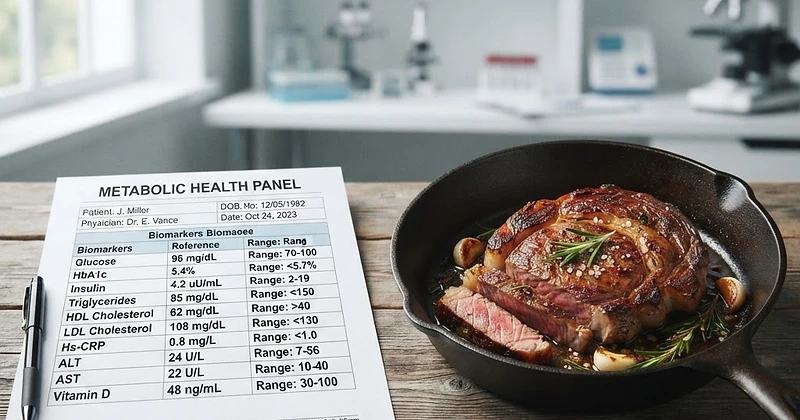
Discover how the strict ruminant-meat Lion Diet affects insulin resistance, how to accurately calculate and interpret HOMA-IR, and which complementary biomarkers to track for peak metabolic health.
We only share products we believe in. Buying through a link may earn us a small commission — thanks for the support. Learn more →
When transitioning to an extreme elimination protocol like the Lion Diet—consuming exclusively ruminant meat (primarily beef, lamb, or bison), salt, and water—your metabolism undergoes a systemic reconfiguration. Glycogen reserves deplete, your liver accelerates gluconeogenesis and ketogenesis, and dietary carbohydrates vanish completely.
For many embarking on this zero-carb path to reverse autoimmune conditions, resolve chronic digestive disorders, or fix metabolic syndrome, tracking internal progress is crucial. Yet standard blood work panels can easily mislead physicians and patients unfamiliar with low-carbohydrate adaptations. Among the most vital objective measurements of your metabolic foundation is the HOMA-IR (Homeostatic Model Assessment of Insulin Resistance).
In this guide, we dive deep into the mechanics of HOMA-IR on the Lion Diet, what your fasting insulin levels actually reveal, and which complementary biomarkers provide a complete picture of your metabolic health.
What Is HOMA-IR and Why Does It Matter?
HOMA-IR evaluates the balance between your fasting blood glucose and your fasting insulin levels. Standard fasting glucose and hemoglobin A1c (HbA1c) tests can remain within conventional "normal" reference boundaries for a decade while an individual develops severe hyperinsulinemia. In those scenarios, the pancreas compensates by pumping out massive amounts of insulin just to keep circulating sugar under control.
By quantifying how hard your pancreas must work to maintain fasting blood sugar, HOMA-IR exposes early metabolic strain long before high blood glucose registers on standard diagnostic tests. Research in publications such as Kevin Forey MD's metabolic protocols and clinical studies highlight HOMA-IR as a crucial clinical index for identifying underlying insulin resistance.
How HOMA-IR Is Calculated
The standard formula for calculating HOMA-IR relies on an overnight fasting draw:
- Formula (US units):
[Fasting Glucose (mg/dL) × Fasting Insulin (µIU/mL)] / 405 - Formula (SI units):
[Fasting Glucose (mmol/L) × Fasting Insulin (mIU/L)] / 22.5
Target Ranges: Standard vs. Optimal
- Optimal Insulin Sensitivity: < 1.0 (Indicative of exceptional metabolic health)
- Early / Mild Insulin Resistance: 1.0 – 1.9
- Moderate Insulin Resistance: 1.9 – 2.9
- Severe Insulin Resistance: > 3.0
On a strict zero-carb regimen like the Lion Diet, an optimal target for most individuals is a score below 1.0, driven down by remarkably low resting insulin secretion.
The Fasting Insulin Test: The Linchpin of Carnivore Blood Work
A conventional fasting blood glucose test provides only half the equation. Ordering a fasting insulin test on carnivore provides direct visibility into basal pancreatic beta-cell activity.
Standard laboratory ranges for fasting insulin often list reference limits between 2.0 and 20.0 µIU/mL. However, an individual with a fasting insulin of 18 µIU/mL is experiencing significant metabolic stress, even if technically flagged as "normal" by commercial lab reference values. In optimal metabolic contexts, fasting insulin frequently settles between 2.0 and 5.0 µIU/mL.
Because the Lion Diet eliminates exogenous sugar, starches, and processed industrial seed oils, baseline pancreatic stimulation decreases significantly, often driving fasting insulin down into optimal single-digit ranges.
The Lion Diet Phenomenon: Physiological Insulin Resistance Explained
When reviewing blood work for insulin resistance on the Lion Diet, individuals occasionally experience an apparent paradox: their fasting insulin drops to ultra-healthy ranges (e.g., 3 µIU/mL), but their morning fasting glucose hovers between 95 and 105 mg/dL. In experienced zero-carb practitioners, this produces a HOMA-IR between 0.7 and 0.8—still very sensitive—yet the elevated fasting sugar prompts unwarranted concern from conventional practitioners.
This occurrence is known as adaptive glucose sparing or physiological insulin resistance:
- Cortisol and the Dawn Phenomenon: In the early morning, cortisol and growth hormone stimulate the liver to release a burst of glucose via gluconeogenesis to facilitate waking alertness.
- Muscle Glucose Sparing: Peripheral tissues, including skeletal muscle, switch their primary fuel source to fatty acids and ketone bodies. To preserve circulating glucose for tissues that require it (such as the brain and red blood cells), muscle tissue becomes temporarily non-receptive to insulin.
Unlike pathological insulin resistance—which presents with concurrent elevations in glucose, insulin, and circulating triglycerides—adaptive glucose sparing presents with rock-bottom baseline insulin, minimal triglycerides, and elevated HDL cholesterol.
Key Metabolic Biomarkers to Track on Zero Carb
HOMA-IR is essential, but it is most informative when viewed alongside a broader metabolic panel. As outlined in comprehensive overviews like GoCarnivore's analysis of carnivore blood work, evaluating contextual markers ensures a complete assessment.
1. Triglyceride-to-HDL Ratio
The ratio of fasting triglycerides to High-Density Lipoprotein (HDL) cholesterol serves as a reliable surrogate marker for vascular and metabolic status:
- Ideal Ratio: < 1.5 (closer to 1.0 or lower is optimal)
- Elevated Risk: > 2.0 suggests underlying atherogenic dyslipidemia and persistent metabolic dysfunction.
On a Lion Diet, triglycerides typically plummet (often settling between 40 and 70 mg/dL), while HDL frequently rises, resulting in a favorable ratio.
2. Hemoglobin A1c (HbA1c)
HbA1c estimates your average blood glucose over a 90- to 120-day timeframe by measuring glycation on hemoglobin molecules. While a reading under 5.4% is desirable, remember that low-carb diets can extend red blood cell lifespan. An older red blood cell has more time to gather glycation, which can occasionally elevate HbA1c slightly without reflecting poor glucose control.
3. High-Sensitivity C-Reactive Protein (hs-CRP)
A primary driver of insulin resistance is systemic low-grade inflammation. The hs-CRP test measures vascular and systemic inflammatory markers. On an elimination diet like the Lion Diet, which strips away plant lectins, oxalates, and chemical additives, optimal values typically sit well below 0.5 mg/L.
4. Fasting Triglyceride-Glucose (TyG) Index
Calculated as ln[Fasting Triglycerides (mg/dL) × Fasting Glucose (mg/dL) / 2], the TyG index serves as an alternative or complementary indicator to HOMA-IR. As noted in clinical analyses from Kevin Forey MD, the TyG index offers reliable insight into hepatic and peripheral insulin sensitivity without being subject to the acute pulsatile variability of fasting insulin.
How to Prepare for Accurate Lab Testing on the Lion Diet
To avoid skewed results on your next metabolic draw, prepare using these clinical best practices:
- Fast for 12 Hours: Fast overnight for 12 to 14 hours. Avoid testing during an extended multi-day fast, as deep ketosis can temporarily elevate physiological glucose sparing and distort resting insulin values.
- Avoid Strenuous Exercise Prior to the Draw: Vigorous resistance training within 24 to 48 hours of testing can transiently elevate liver enzymes (AST/ALT), blood glucose, and creatine kinase.
- Hydrate with Plain Water: Dehydration artificially concentrates serum markers, leading to falsely elevated hematocrit, creatinine, and lipid panels. Drink ample water before the blood draw, omitting supplementary electrolytes on testing morning.
- Allow Adequate Adaptation: Avoid scheduling blood panels during your initial three weeks on the Lion Diet. Wait at least 8 to 12 weeks for hepatic enzyme regulation, ketone adaptation, and electrolyte stability to establish a reliable baseline.
Frequently Asked Questions
Can excessive protein on the Lion Diet spike insulin and ruin my HOMA-IR?
While protein ingestion does stimulate a modest release of insulin to drive amino acids into muscle cells, this response is balanced by the simultaneous secretion of glucagon. Without dietary carbohydrates present, basal fasting insulin levels remain consistently low throughout the day.
Why did my doctor express concern about my HOMA-IR despite a low fasting insulin?
If your fasting glucose registered higher due to the dawn phenomenon or acute testing anxiety while your insulin sat at 4 µIU/mL, an uncontextualized look at glucose alone might draw scrutiny. Provide your clinician with the complete mathematical HOMA-IR score alongside your low triglyceride levels to present the full physiological context.
The Bottom Line
The Lion Diet serves as a powerful nutritional intervention for resetting digestive function and eliminating inflammatory triggers. However, verifying your metabolic trajectory requires objective, contextual lab data. By tracking HOMA-IR alongside fasting insulin, the TG:HDL ratio, and hs-CRP, you gain clear, quantitative validation of your metabolic health.