When newcomers explore the Lion Diet—the ultimate elimination protocol consisting solely of ruminant meat (most commonly beef), water, and salt—one immediate concern surfaces: Can I actually afford this?
Social media feeds are flooded with influencers searing $25-a-pound grass-fed ribeyes in cast iron skillets every single night. While that lifestyle sounds delicious, it paints a false picture of what an elimination diet requires. The reality is that eating strictly beef does not require a luxury budget. In fact, when executed correctly, an affordable carnivore diet can cost less than the standard American diet laden with processed snacks, dining out, and specialty health products.
In this guide, we break down actionable strategies to run a cheap beef lion diet protocol, keep your grocery bill predictable, and ensure you get adequate calories and fats to thrive.
Understanding the Lion Diet Blueprint
Popularized by advocates like Mikhaila Peterson, the Lion Diet strips nutrition down to its absolute baseline: ruminant animal meat, unrefined salt, and water. Ruminants possess a unique multi-chambered stomach capable of fermenting fibrous plant material, resulting in meat rich in bioavailable micronutrients, complete proteins, and stable saturated fats.
Unlike broader carnivore plans that allow eggs, pork, poultry, and dairy, the Lion Diet excludes these potential irritants. This simplicity is an advantage for your wallet: you bypass entire grocery store aisles, buying only beef cuts that meet your caloric and nutritional needs.
Grass-Fed vs. Grain-Fed: The Budget Truth
One of the most persistent myths in the carnivore community is that you must eat 100% grass-finished beef to heal or achieve deep ketosis. While grass-finished ruminants have a marginally higher omega-3 profile, conventional grain-finished beef remains a nutritional powerhouse. Both grain-fed and grass-fed beef offer bioavailable zinc, heme iron, carnitine, creatine, B-vitamins, and essential fatty acids.
If pasture-finished steaks fit your grocery budget, by all means, buy them. But if your goal is an authentic lion diet budget, conventional USDA Choice or Select beef from the grocery counter is completely fine and yields virtually identical metabolic results.
The Best Cheap Beef Cuts for the Lion Diet
Steakhouse staples like filet mignon, ribeye, and New York strip carry premium price tags because of tenderness, not nutrient density. To master the budget Lion Diet, shift focus toward flavorful, economical cuts that deliver exceptional fat-to-protein ratios.
1. 73/27 and 80/20 Ground Beef
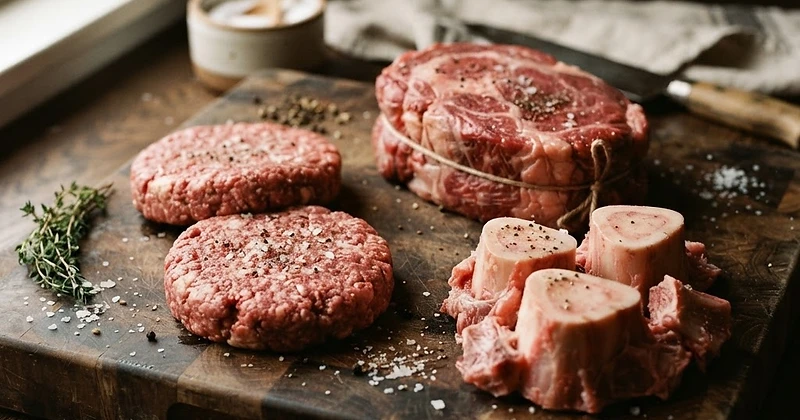
Ground beef is the indisputable cornerstone of an affordable carnivore diet. Leaner blends (such as 90/10 or 93/7) are often more expensive and lack the energy-dense animal fat needed to fuel a zero-carb metabolism. High-fat grinds like 80/20 or 73/27 provide plenty of calories at a fraction of the cost per pound. Form them into thick smash patties, sear them in a pan, season with coarse salt, and enjoy a complete meal in under ten minutes.
2. Chuck Roast
Cut from the shoulder, chuck roast contains substantial connective tissue and intramuscular fat. When prepared with low-and-slow cooking methods—such as braising in a Dutch oven with water and salt, using a slow cooker, or running a sous-vide cycle—the tough collagen breaks down into succulent gelatin. It mimics prime rib at less than half the price.
3. Beef Brisket
Brisket is frequently sold untrimmed (the "full packer") at wholesale price points. While a whole brisket requires a larger upfront purchase, the cost per pound is among the lowest in the butcher case. Slow-roasted in the oven with salt and water, a single brisket yields high-fat, energy-dense meals for an entire week.